In today’s marketing world, every dollar needs to prove its worth. Gone are the days of fluffy metrics. Marketers are under pressure to show that campaigns drive customer acquisition, repeat purchases, and long-term loyalty.
That’s likely why Wyng has seen growing interest from retailers and brands who want to launch proof-of-purchase campaigns. These promotions reward verified buyers with sweepstakes entries, instant-win opportunities, digital rewards, or rebates that motivate customers to buy again and again.
Unlike most promotions, these experiences are directly tied to a sale. Customers aren’t rewarded for filling out a form or liking a post; they’re rewarded for actually buying your products. For marketers under pressure to prove ROI, this connection between campaign engagement and confirmed purchase makes proof-of-purchase activations especially powerful.
How Purchase-Based Promotions Work: 4 Validation Methods
Every proof-of-purchase promotion begins with one essential component: verifying that a customer has purchased the qualifying product or reached the required spending threshold. Whether through receipts, codes, or transaction data, this validation step ensures that every entry or reward is tied to a confirmed purchase.
There are four common approaches to proof-of-purchase campaigns – each with its own advantages, trade-offs, and ideal use cases.
1. Receipt Upload with Manual Verification
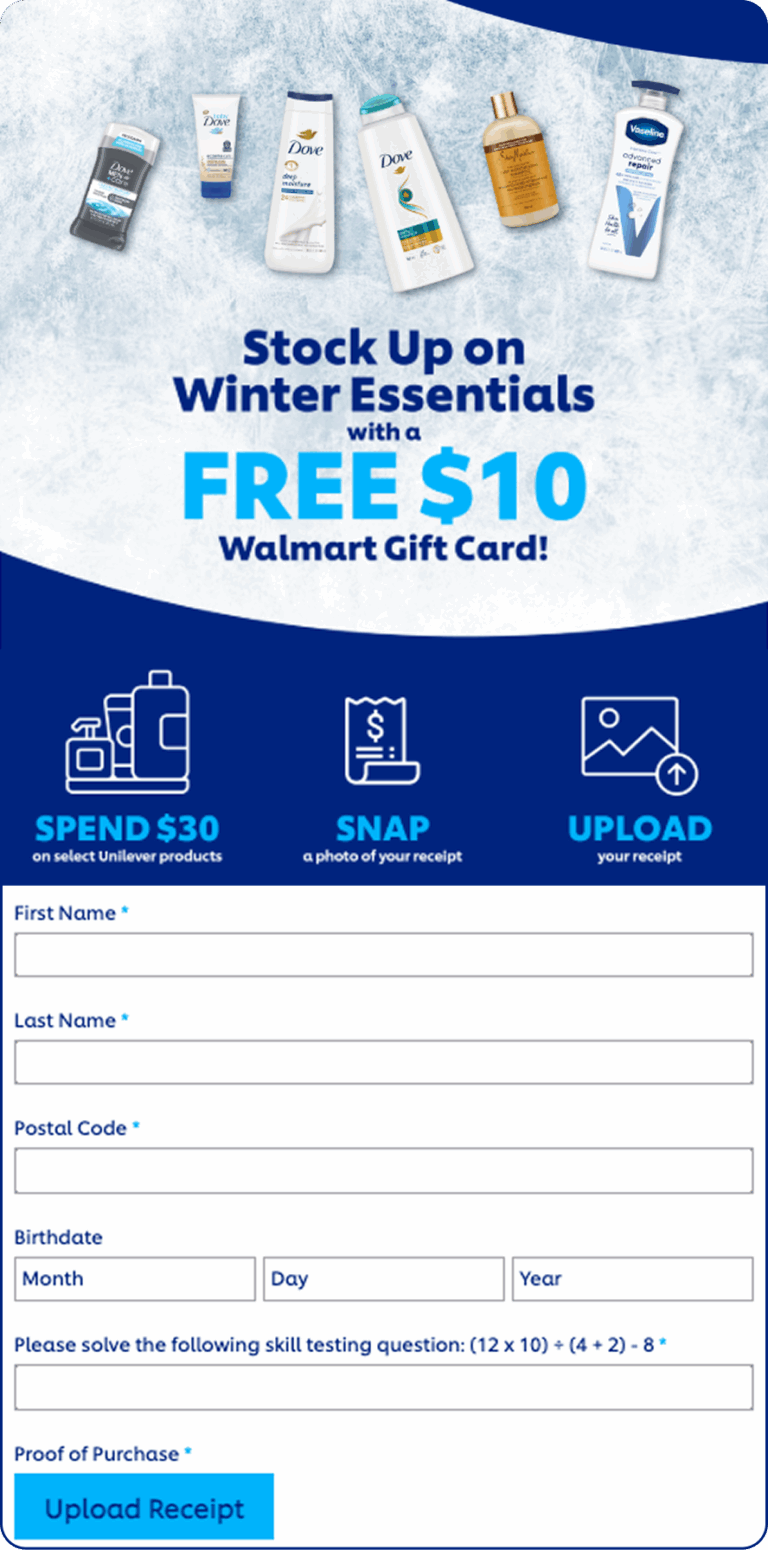
This is the simplest way to get started. Participants upload an image of their purchase receipt to take part in a promotion. It’s easy to implement – you just need a form with an image upload field – and it works across in-store or online purchases (have participants share an image of their printed receipt, or a screenshot of their email confirmation, for example)
With this method, a human has to review each receipt to confirm eligibility before any prizes are awarded. That’s why it’s best suited for campaigns that don’t require instant rewards, like sweepstakes or giveaways. A common best practice is to randomly select more potential winners than you need, then verify their receipts one by one. If someone’s submission doesn’t meet the criteria, you simply move to the next person on the list.
Of course, simplicity comes with a few challenges. Manual review takes time, and there’s more potential for duplicate submissions. While it’s difficult to detect repeated receipts, there are ways to reduce fraud: limit entries per email address or per week, require email or SMS verification, and use tools like Wyng’s Sweepstakes Referrer Blocklist to redirect low-quality traffic from contest-aggregator sites.
Example: Unilever Canada uses receipt upload frequently for sweepstakes programs that reward purchases of verified products or product bundles.
2. Code Validation
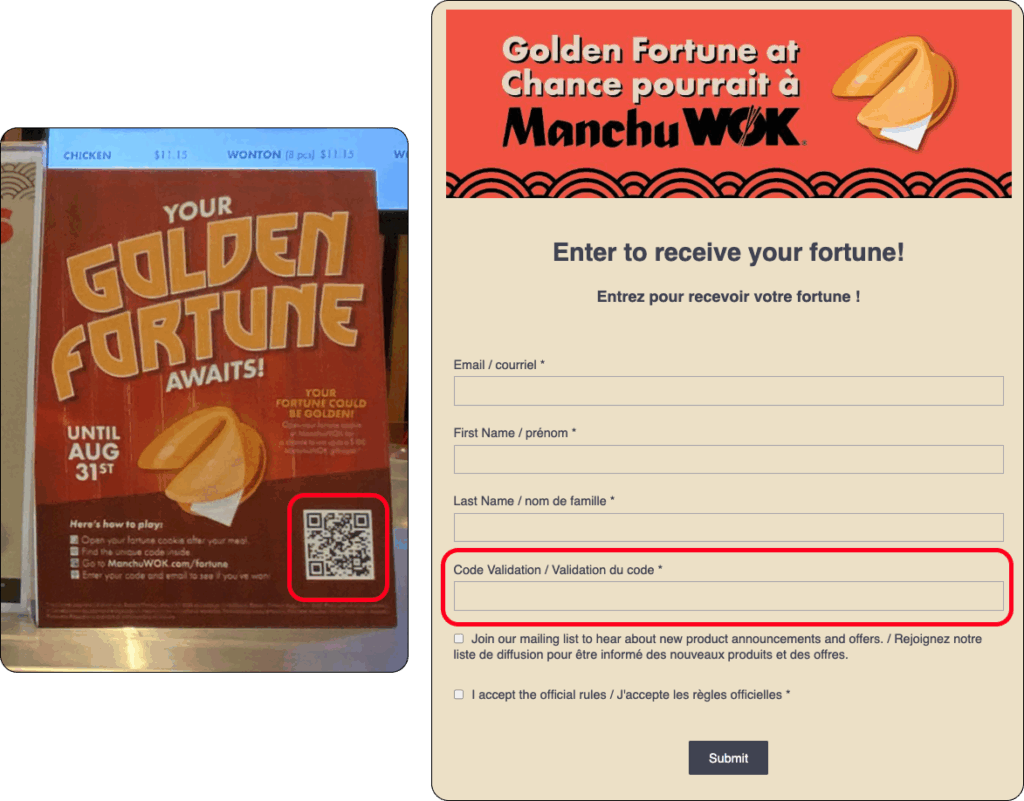
A step up in security, and in setup effort, is code validation. In these campaigns, customers enter a unique code to unlock a reward, prize, or offer.
Years ago, many brands used UPCs (Universal Product Codes) printed on packaging as the entry method. Today, that approach isn’t secure enough – UPCs are publicly searchable and easily shared. Instead, most marketers now use unique, single-use codes printed on receipts, inside packaging, or on inserts distributed with the product.
While code validation provides stronger fraud protection, it does require more planning. Brands must generate and print the codes, then use a verification system to confirm each one in real time and ensure it’s not reused.
Because this method verifies purchases at the individual level, it’s a good fit for higher-value rewards or instant rewards (ie. coupon, promo code to use on next purchase).
Example: Manchu Wok’s “Golden Fortune” promotion placed codes inside fortune cookies given out with each purchase, leading customers to a digital gamified reveal where they could win gift cards. Learn more about Manchu Wok’s Golden Fortune Promotion.
3. Receipt Scan with Automated Verification
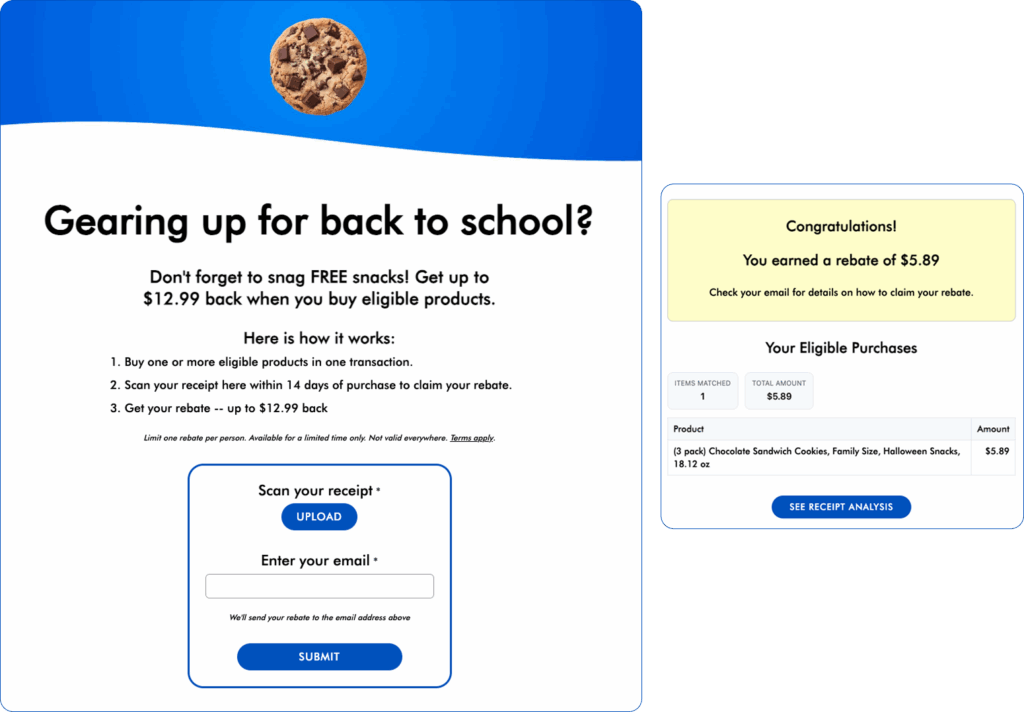
The most advanced (and increasingly popular) method is automated receipt verification using OCR (optical character recognition) technology.
In this approach, the participant uploads their receipt image, and a specialized vendor scans and validates it automatically – sometimes in real time. Depending on the provider, the system can do more than just confirm a purchase; it can extract SKUs, identify qualifying products, and even enrich the data for deeper product insights.
Capabilities vary widely between vendors. Some offer instant validation and immediate feedback (“Congratulations! Your purchase has been verified!”), while others take longer. Coverage also differs by region. Currencies, languages, and receipt formats vary globally, so it’s important to evaluate vendors based on your target markets.
This method offers the strongest fraud prevention and the richest data, but it’s typically the most complex and costly to implement. For large-scale promotions or brands running multiple campaigns a year, though, the speed and precision are often worth it.
Example: A leading food and beverage brand recently used automated receipt scanning for a back-to-school promotion, verifying purchases in real time to offer instant rebates.
4. Integration with Transaction History
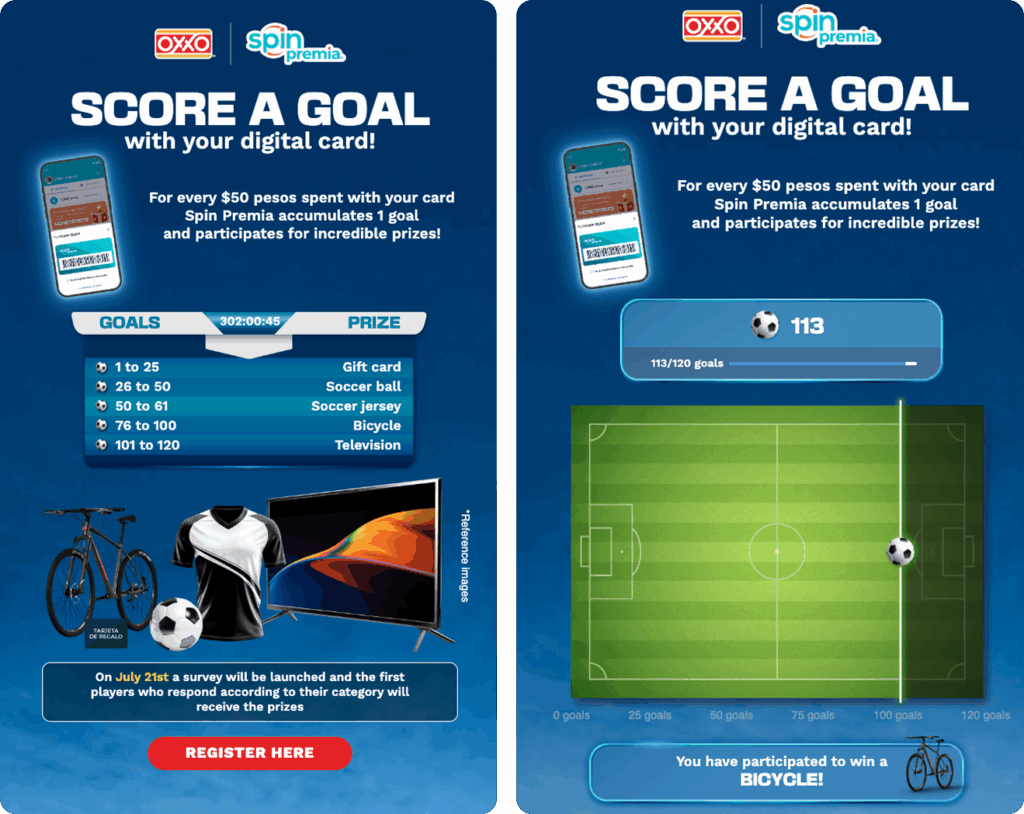
For retailers, another powerful approach is validating purchases through a customer’s transaction history. This method works when a participant is logged into their account or provides identifying information (such as their email, phone number, or loyalty ID), allowing the system to match the promotion to known purchase records.
Because purchases are already captured through an eCommerce platform, POS system, or loyalty database, customers don’t need to upload anything or enter a code. The system simply checks whether they purchased the qualifying product or reached the required spend threshold.
This creates a low-friction experience that is hard to scam. It also enables tiered or spend-based rewards – for example, offering higher-value prizes to loyalty members who spend more, or giving additional spins or entries based on cumulative purchase totals.
Example: OXXO used transaction-history validation for its World Cup promotion, allowing loyalty members to unlock a chance to win prizes automatically based on their verified in-store purchases. Learn more about OXXO’s World Cup Promotion.
Running a Proof-of-Purchase Campaign with Wyng
For brands ready to launch a proof-of-purchase campaign, Wyng offers flexible tools to build and manage these experiences quickly:
- Proof-of-Purchase: Receipt Upload and Proof-of-Purchase: Code Validation templates are available directly in the platform, making setup fast and intuitive.
- For brands already working with a receipt scanning vendor, Wyng integrates easily – letting you build your campaign landing page and mechanics in Wyng while using your vendor to handle automated receipt verification.
- For retailers, Wyng integrates with eCommerce and loyalty platforms to validate purchases through transaction history and dynamically reward customers based on actual spend.
Proof-of-purchase promotions are more than just another campaign type. They’re a strategy for connecting marketing investment directly to sales, building loyalty, and capturing valuable first-party data along the way. Contact us to learn more about launching proof-of-purchase campaigns with Wyng.