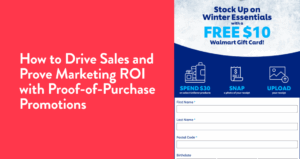
Most CPG promotions collect entries. Few collect insight. The gap between a campaign that drives 200,000 sweepstakes entries and one that actually builds a customer asset comes down to the platform behind it and whether it was designed to do more than run a prize draw. Selecting a consumer engagement platform is one of the higher-stakes technology decisions a CPG marketing team makes
Wyng is the leading Data Capture & Engagement Platform for global enterprises and large CPG brands, enabling them to create interactive experiences, capture consented consumer data, and activate it to drive revenue.
Why CPG Brands Need a Dedicated Consumer Engagement Platform
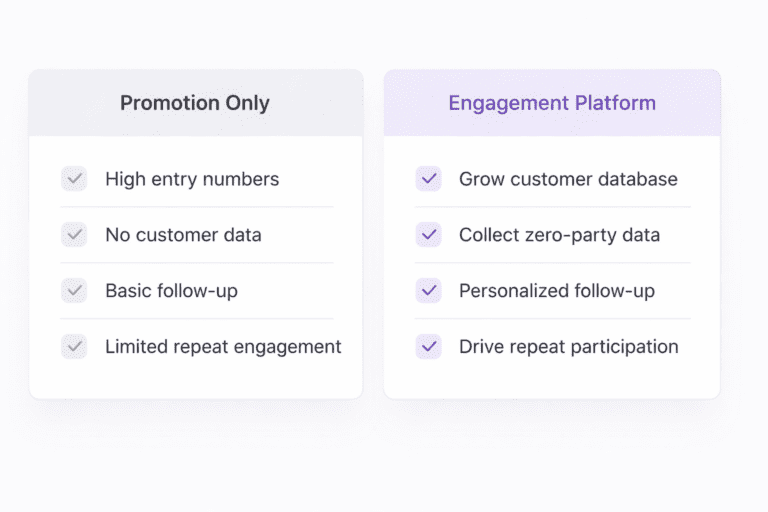
Most CPG brands don’t necessarily struggle to run promotions. Instead, what they struggle to do is make those promotions worth more than the prize budget. A sweepstakes that drives 200,000 entries but leaves you with no usable customer data, no opt-ins, and no follow-up strategy is expensive entertainment.
A dedicated engagement platform changes the ROI calculation entirely. Instead of walking away with entry counts, you walk away with opt-ins, preference signals, and a customer record you can act on immediately and in future campaigns. Wyng, for example, is a Data Capture & Engagement (DCE) platform used by brands like Unilever, L’Oréal, and Estée Lauder to run everything from instant-win games to preference centers to receipt upload programs, all in one place, without needing a developer for every campaign.
The Full Spectrum of CPG Engagement Formats
One of the most important questions to ask any platform vendor is: what can it actually run? The range of formats a platform supports determines how flexible your campaign strategy can be across seasons, brands, and audiences.
A mature consumer engagement platform for CPG should handle a full range of promotions and data capture without custom builds. Core formats like sweepstakes, instant-win games, and gamified experiences drive engagement and opt-ins, while tools such as product finder quizzes deliver high ROI by collecting preference data and guiding purchases. Receipt upload programs tie engagement to real sales, and formats like UGC contests, polls, surveys, and preference centers support different stages of the customer journey.
What to Evaluate: 6 Features That Determine Platform Fit
When you get past the vendor demos, there are six capabilities that tend to separate platforms that scale from those that don’t.
1. No-Code Experience Builder
Your team should be able to build, test, and publish a new campaign experience without filing a developer ticket. When every layout change requires dev support, campaign calendars get held hostage to sprint cycles.
Look for:
- Drag-and-drop interface with real-time preview across mobile and desktop
- Branching logic (if the user selects X, show Y)
- Pre-built templates that are starting points, not cages
Wyng’s Experience Studio is designed for this, compressing build time from weeks to days.
2. Zero-Party Data Architecture
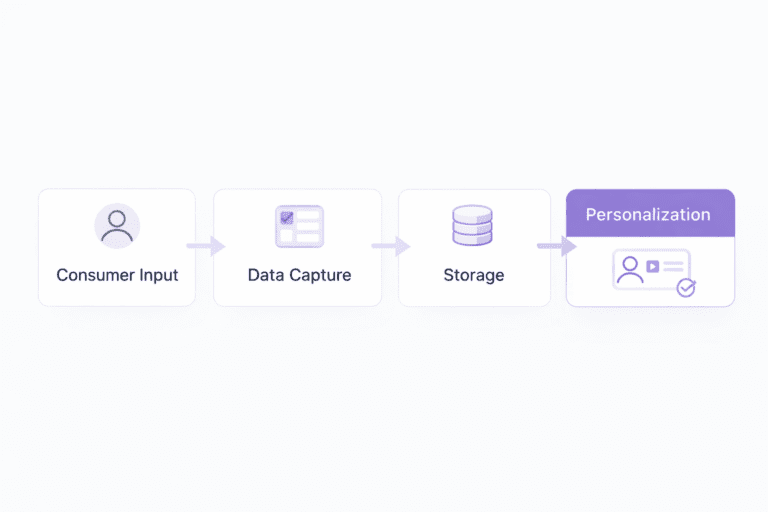
Zero-party data, what customers explicitly tell you about themselves, doesn’t decay with cookie deprecation, doesn’t require inference, and is more accurate because it’s given voluntarily.
For CPG brands specifically, the most valuable zero-party signals are:
- Flavor or variant preferences which SKUs a household actually wants
- Occasion-based buying habits everyday use vs. gifting vs. seasonal
- Retailer affinity where they actually shop
- Household composition who they’re buying for
These can’t be inferred from a purchase. When asked inside a quiz, product finder, or preference center, completion rates are far higher than a standalone survey.
3. Fraud Prevention and Compliance Controls
High-volume promotions attract fraud, duplicate entries, bot submissions, and invalid receipts can distort your data and expose you to legal liability. Your platform needs native controls, not bolted-on third-party tools.
In CPG promotions, fraud shows up in predictable patterns:
- Receipt farms submitting the same purchase image with minor pixel alterations
- Bot networks cycling through email variations to claim multiple prizes
- VPN users bypassing geographic restrictions on regionally-scoped campaigns
Ask vendors about their receipt validation logic, OCR alone isn’t enough, and how many fraudulent entries they rejected in a recent campaign at comparable volume. If they can’t answer, the controls aren’t as mature as the sales deck suggests.
4. Real-Time Personalization
The value of preference data is measured by what you do with it. A platform should let you act on collected data immediately, serving personalized content, adjusting offers, or routing users through different experience paths based on what they’ve shared.
For example, in a single campaign:
- Someone who indicated they cook for a family of five gets a bundle offer
- Someone who said they cook solo gets a single-serve format
Same campaign, different paths, higher relevance.
5. Tech Stack Integration Quality
A consumer engagement platform lives in the middle of your martech ecosystem. It needs to send data to your CDP, trigger workflows in your ESP, and connect to your CRM, reliably and bidirectionally.
When evaluating vendors, ask them to show you:
- The specific connectors they maintain
- The frequency of data syncs
- How they handle failures mid-campaign
- Whether each integration is native or Zapier-based
Native integrations are generally stronger than Zapier bridges, they behave very differently when a sync fails. When you’re running a campaign that’s collecting 50,000 entries in 48 hours, you need data moving cleanly.
6. Scalability and Uptime During Peak Events
Holiday campaigns, Super Bowl activations, and product launch moments are precisely when you need your platform to perform. Traffic spikes are predictable, and your vendor should have a clear answer for how they handle them.
Ask for:
- Load test results at volumes comparable to your peak
- Documented uptime from past peak events
- Specific customer references from Super Bowl-level traffic moments
A vendor who has handled traffic at this scale should be able to show it, not just claim it.
The 11 Criteria to Include in Your CPG Engagement Platform RFP
When you send a written RFP to vendors, structure it around these eleven dimensions, and ask for written responses before scheduling any demo calls. Written responses let you compare vendors on the same criteria, surface gaps before you invest time in a live walkthrough, and prepare sharper questions for the conversation.
- Experience formats — List every campaign type you run or plan to run. Don’t let vendors answer generically, ask them to confirm native support (not custom builds) for each format on your list.
- No-code builder — Ask whether non-technical team members can build, test, and publish a campaign independently. Ask for a time estimate: how long does it take to go from brief to live?
- Zero-party data capture — Specify which data types matter most to your brand flavor preference, purchase occasion, retailer affinity and ask how each one is collected and stored.
- Fraud and compliance controls — List every compliance framework your campaigns must meet (GDPR, CCPA, COPPA, state-level regulations) and ask vendors to confirm how each is handled natively.
- Personalization — Describe your current and target personalization use cases. Ask vendors to show you branching logic in action, not just describe it.
- Integrations — List every platform in your current martech stack and ask vendors to confirm native connector status for each, sync frequency, and failure handling.
- Analytics and reporting — Note any BI tools your team uses and confirm whether data exports are included or gated behind a higher pricing tier.
- Scalability — Give vendors your peak campaign traffic estimate and ask for documented proof, load test results or uptime data not just a verbal assurance.
- Security and privacy — Confirm which certifications are current (SOC 2, ISO 27001) and whether data residency options exist if your campaigns span multiple markets.
- Onboarding and support — Ask for SLA specifics: dedicated CSM, launch support hours, escalation path. Note your go-live timeline and confirm they can meet it.
- Pricing model — Ask what’s included at each tier and what triggers overage fees. Per-experience pricing behaves very differently from a platform fee at high campaign volume.
How Does a Consumer Engagement Platform Compare to Basic Promotion Tools?
Not all platforms are built for the same job. Here’s the practical difference between a basic promotional tool and an enterprise-grade consumer engagement platform:
| Capability | Basic Promotional Tools | Enterprise Engagement Platforms |
|---|---|---|
| Campaign formats | Sweepstakes, basic entry forms | Full suite: instant-win, receipt upload, quizzes, UGC, preference centers |
| Data capture | Email address and entry count | Zero-party preference data, progressive profiling, opt-in consent flows |
| Builder | Template-locked, developer required for changes | No-code drag-and-drop; non-technical teams launch independently |
| Fraud controls | Duplicate email check | Receipt OCR validation, bot detection, geographic enforcement |
| Integrations | Webhook or Zapier | Native CDP, CRM, and ESP connectors with bidirectional sync |
| Personalization | Same experience for every user | Real-time branching logic based on stated preferences |
| Scalability | Shared infrastructure, no guarantees | Dedicated capacity, load-tested for peak campaign events |
| Compliance | Basic terms and conditions | GDPR, CCPA, SOC 2, age-gate enforcement, data residency options |
Most tools check some of these boxes. The question is which gaps you can afford and whether those gaps show up during a routine campaign or during your highest-traffic moment of the year.
Choosing the Right Platform for Where You're Going, Not Where You Are
The temptation in platform selection is to optimize for what you’re running today. Resist it. The right question is: what will we need to do in 18 months? A platform that handles your current sweepstakes volume might buckle under an integrated loyalty program, a global rollout, or a portfolio-wide preference center. Evaluate for where you’re going, not where you are and use the RFP template above to hold every vendor to the same standard.
Wyng powers promotions and data capture for 250+ brands, from global CPG leaders to mid-market challengers. Book a demo today to see the platform in action with your specific use cases relevant to your stack and confirm how data syncing works in high-volume scenarios.
Frequently Asked Questions
How is a consumer engagement platform different from a CDP or CRM?
A CDP stores and unifies customer data, a CRM manages known contacts and sales workflows. A consumer engagement platform sits in front of both, it's the layer that creates the experiences (quizzes, sweepstakes, receipt uploads, preference centers) that generate the zero-party data your CDP unifies and your CRM acts on. Most enterprise CPG brands run all three.
Should we build our own engagement tools instead of buying a platform?
You can, but it rarely pencils out. Custom-built tools require dedicated engineering for every new format, every fraud rule, every integration and they tend to break when compliance frameworks change or traffic spikes. A dedicated platform spreads that development cost across hundreds of brands and gives your team a no-code builder for day-to-day campaigns.
How do we measure ROI on a consumer engagement platform?
Look beyond entry counts. The metrics that matter are opt-in rate, zero-party data captured per session, cost per qualified profile, and downstream conversion among participants versus non-participants. A campaign that drives 50,000 entries with a 40% opt-in rate and measurable purchase lift is worth far more than one that drives 200,000 anonymous entries.
Can one platform support multiple markets with different privacy regulations?
Yes, if it's built for it. Look for centralized control of consumer-side and brand-side privacy policies, market-specific consent flows, data residency options, and native support for GDPR, CCPA, and regional frameworks like PIPEDA. Global CPG brands typically run dozens of markets from a single account with localized templates and compliance settings per region.