If you’re running 40 brands in 20 markets, here’s how to do this once and roll it out everywhere instead of rebuilding each time.
Most of a customer’s relationship with a brand happens between purchases, in moments like discovering a product, trying it, sharing a preference, and coming back. Wyng defines gamified loyalty as the use of mechanics such as streaks, tier progression, unlocks, bonuses and other activity based reward structures, to motivate participation, encourage repeat engagement, drive desired behaviors, and deepen the customer’s relationship with a brand, across the full journey and across in store, web, app and push.
For a CPG portfolio running dozens of brands across many markets, that in-between engagement is happening today. It just isn’t rewarded, measured, or built the same way twice.
Why portfolio scale changes the problem
The overwhelming majority of consumer goods revenue moves through retailers and ecommerce marketplaces, even where individual brands run their own small direct to consumer sites. Across a portfolio, that means the same structural gap repeats 40 times over. No single brand sees enough of the transaction to anchor a conventional points for spend program, and rewarding engagement is the practical route to a program at all.
The portfolio adds a second problem on top of the first. Each brand solves that gap separately, usually with a different vendor, a different build and a different data model, so nothing learned in one market carries into the next.
Step 1: Audit what’s already running
Before building anything new, pull an inventory of every gamified promotion currently live or recently run across the portfolio. Note the mechanic type (sweepstakes, instant win, points, referral), the vendor, and the market.
This surfaces the redundancy immediately. Most portfolios find they’ve paid to build the same three or four mechanic types dozens of times over, under different vendors, with no shared data and no visibility into which brands are already rewarding the engagement that happens between purchases.
Step 2: Build the mechanic library once
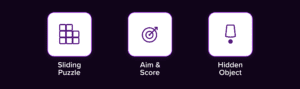
Take the handful of mechanic types that actually work for the category, such as sweepstakes, scratch off, tiered points, and referral rewards, and build each as a reusable template covering the rules engine, entry validation, prize fulfillment logic, and data capture, all decoupled from any single brand’s look and feel.
Mechanics work as scaffolding. They sustain participation long enough for a customer to form a real connection with the brand, and that connection is the actual reward. Wyng’s library of proven game formats gives central teams a starting set to configure from, rather than briefing a new build from zero for every brand, and it sits alongside whatever loyalty program, CRM, or CDP each brand already runs rather than replacing it.
Step 3: Create the brand skin layer
Layer brand identity on top of the mechanic library as a separate, swappable layer covering logo, color palette, copy tone, product imagery, and reward structure. A brand team should be able to launch a fully on-brand program by filling in this layer, without touching the underlying mechanic.
Central account governance is what makes this workable at 40-brand scale. A central strategy or loyalty team can see and manage configuration across every brand from one place, while individual brand teams keep control of their own creative layer without needing separate admin builds each time.
Step 4: Template the compliance layer by market
Map the promotional law, data privacy requirements, and consent flows for each of the 20 markets into standalone compliance templates that plug into any mechanic in the library. Prioritize the markets with the most active or upcoming campaigns first.
Wyng’s localization support is built for this layer specifically, so a new market launch becomes an exercise in selecting or adapting an existing compliance template rather than re-clearing an entire campaign with legal from scratch.
Step 5: Turn engagement into owned data
Route every rewarded action, regardless of brand or market, into consented first-party and zero-party data that flows into the existing CRM, CDP, or data warehouse. This is what turns 40 isolated campaigns into a single portfolio-level view, showing which mechanics drive repeat participation, which markets over-index on mobile entry, and which rewarded behaviors actually predict lifetime value.
This is the step that compounds. An always-on program built this way keeps building on what it learns about a customer, rather than resetting with every new campaign.
What this looks like for the team running it
A new brand or market launch moves from a multi-week custom build to picking the mechanic from the library, applying the brand skin, dropping in the market’s compliance template, connecting it to the existing data stack, and launching. For portfolios running this through internal build teams, systems integrators, or agency partners, Wyng’s services team supports the rollout so the central team doesn’t have to become mechanic-building experts themselves. One consumer goods enterprise uses this model to scale consumer activations across 45 markets.
Talk to Wyng to map your portfolio’s mechanic library and cut campaign build time across every brand you manage.
Frequently Asked Questionsc
Do we need to migrate all 40 brands at once to make this work?
No. Most portfolios start with one or two brands, then add brands and markets incrementally as new campaigns come up for renewal.
What if a brand's current program doesn't fit any of the existing mechanics in the library?
The mechanic library is built to be extended. A genuinely new mechanic type gets built once, then joins the library for every other brand to draw from going forward.
Does this replace our existing loyalty program or CRM?
No. The mechanic, localization, and governance layers sit alongside the loyalty platform, CRM, CDP, or data warehouse each brand already uses. The existing program stays the system of record; this layer rewards and captures the engagement it currently misses.
How is this different from just using the same agency for every brand?
Using one agency doesn't guarantee shared infrastructure. Building the mechanic templates, compliance templates, and data model once means they're reusable at the portfolio level regardless of which internal team, systems integrator, or agency partner executes the creative layer for a given brand.