Most loyalty programs reward purchases. The best ones reward attention.
Gamification is the mechanism that makes that possible. By embedding game mechanics, spin-to-win, quizzes, countdowns, challenges into the loyalty experience, brands give customers a reason to engage between transactions, not just because of them. The result is a relationship that’s more frequent, more personal, and more durable than a points balance alone can produce. Wyng enables enterprise brands to run promotions, contests, gamification and guided selling , all from one platform
How Gamification Builds Deeper Loyalty
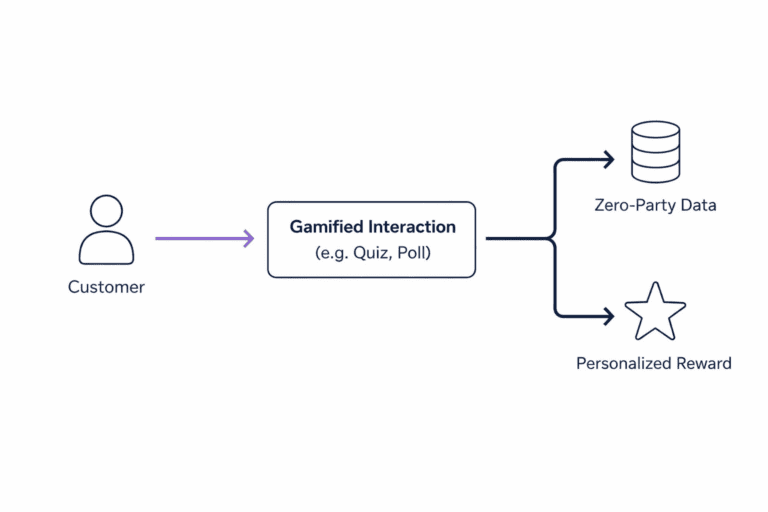
A gamified loyalty program makes the customer an active participant. This interactivity changes the nature of the relationship and makes data collection feel like a fair exchange.
Instead of just receiving a discount, a customer might complete a preference quiz to unlock a spin-to-win or play a trivia game about your products to receive a personalized recommendation. When customers invest even a few seconds of attention, they form a stronger connection to your brand. This shows up in return visit rates, opt-in quality, and downstream purchase behavior.
Example: Unilever ran a spin-to-win experience through Wyng that drove repeat engagement during a promotional period, using configurable odds and reward tiers to control prize distribution across a high-volume audience.
Matching Gamification Formats to Loyalty Goals
The mechanics you choose shape the engagement you generate. To build an effective program, align the format with your primary business objective. Here’s a breakdown of the most common loyalty objectives and the formats best suited to achieve them.
- Drive Repeat Visits: Countdown calendars, bracket competitions, and challenge-based streaks are designed for return engagement. They give customers a reason to come back daily or weekly, building a habit of interaction that isn’t tied to a pending purchase.
- Example: Sony Music used a “10 Days of Giveaways” countdown calendar to keep fans engaged across an extended campaign, with daily unlocks driving consistent traffic back to the experience.
- Capture Preference Data: Quizzes, swipe polls, and trivia formats turn data collection into a game. A customer who shares their skincare concerns or travel style to get a result sees it as playing rather than filling out a form. The resulting zero-party data is willingly shared and immediately useful for personalization.
- Reward Purchases: Instant win formats like spin-to-win, scratch-offs, and tap-to-reveal work naturally with proof-of-purchase mechanics. The possibility of winning creates genuine motivation to complete a qualifying action, driving incremental sales in addition to engagement.
- Example: Arm & Hammer ran a “Hosting Hack Showdown” contest that combined user-generated content submission with gamified voting, building brand affinity while generating social proof.
- Build Brand Knowledge: Memory games and trivia tied to your product range both entertain and educate. A customer who plays a brand-themed match game will understand your product lineup more deeply than one who simply scrolled through a category page.
Connect Engagement to Your Data Strategy

Gamification that doesn’t feed a data strategy is just entertainment. The value comes from connecting what customers do in a gamified experience to what you show them next. When a customer’s quiz responses, game participation, and reward preferences are captured in a unified profile, you can personalize their next interaction based on what they have told you about themselves.
This is why platform architecture is critical. If your gamification tools, data capture, and personalization engine are in separate systems, the feedback loop either breaks or moves too slowly to be effective. Without that connection, gamification produces engagement metrics that don’t translate to revenue, high play rates, low repurchase, and no customer data you can act on the next day.
Why Wyng for Gamified Loyalty?
Wyng augments your existing loyalty tech rather than replacing it, giving enterprise brands four advantages that show up in every campaign:
Accelerate delivery and scale — Seamless integration with your existing stack, global templates and themes, and localization support so one program can run across markets without rebuilding from scratch.
Streamline complex promotions — Built-in incentive delivery, a customizable rules engine, and real-time personalization handle the operational complexity that usually eats campaign timelines.
Get actionable customer data — Every interaction feeds engagement data, zero and first-party data, and metrics & insights into unified profiles you can act on.
Reduce risk, increase control — Central account governance, enterprise-grade security, and consumer data compliance built into the platform, not bolted on.
How Wyng Powers Loyalty Gamification at Scale
The Wyng Experience Studio includes every format marketers need for loyalty gamification, spin-to-win, scratch-offs, countdown calendars, bracket competitions, trivia quizzes, and more. All experiences feed into the same unified customer profiles, allowing you to act on zero-party data in real time.
At scale, the operational details matter as much as the formats. Winner selection, participation limits, unique code delivery, and proof-of-purchase gating all need to run without developer involvement. Fraud controls need to catch duplicate entries and bot traffic before they corrupt your reward pool. And the data collected inside each game mechanic needs to flow into customer profiles immediately, not in a nightly batch, so that the next interaction can be personalized based on what just happened.
The right starting question isn’t which format to run, it’s whether your platform can connect what a customer does in a game to what they see next.
Brands including Unilever, L’Oréal, and LEARFIELD use Wyng to run loyalty and engagement programs at scale. If you’re ready to build loyalty experiences your customers want to return to, contact us to see Wyng’s gamification capabilities in action.
Frequently Asked Questions
How is gamified loyalty different from a traditional points-based program?
Traditional loyalty programs reward purchases. Gamified loyalty rewards a broader set of behaviors: quizzes, check-ins, streaks, content sharing, timed challenges giving customers reasons to engage between transactions, not just during them. That's where habit formation and preference data actually get built.
Do I need to replace my existing loyalty platform to add gamification?
No. Gamified loyalty works as a layer on top of your existing infrastructure, with Wyng integrating with platforms like Annex Cloud, Antavo, and Voucherify, plus your CRM, CDP, and ESP. Most enterprises treat gamification as the execution layer for activations while their loyalty platform remains the system of truth for points, tiers, and member records.
How do you prevent fraud and bots in gamified promotions?
Effective controls combine authenticated access (sign-in, OTP, unique codes), participation limits per user, CAPTCHA for suspicious traffic, and intelligent bot defense that scores submissions in real time. IP and email blocklists, secure reward distribution, and audit trails let you isolate bad actors before rewards are fulfilled.
What metrics should I track to measure gamified loyalty success?
Track three layers: engagement (participation, completion, repeat play), data (opt-in rate, profile attribute completion, zero-party data per session), and business (incremental purchase rate, AOV lift, retention among participants vs. non-participants). The key is having these in real time, so you can adjust a live program rather than waiting for a post-campaign readout.