Marketing gamification is the use of game mechanics like spin-to-win wheels, instant win contests, quizzes, and prize-based challenges to turn passive audiences into active participants. It drives opt-ins, surfaces genuine customer preferences, and gives brands the kind of first-hand data that behavioral tracking can’t reliably produce.
Wyng is the enterprise gamification platform that makes it easy to launch on-brand games like Spin to Win, Scratch Off, Trivia Quiz, Sliding Puzzle, and Aim & Score, capturing zero-party and first-party data with every play and delivering it directly to your CRM and CDP.
Why Brands Are Turning to Gamification Now
Third-party cookies are eroding and privacy regulations are tightening. Consumers have learned to ignore static forms and generic pop-ups. Gamification reframes the data exchange entirely. When someone spins a wheel for a discount or works through a product quiz, they’re not thinking about data collection. They’re thinking about the experience. What they share is more accurate than anything inferred from behavioral tracking, because they chose to share it.
Types of Gamified Marketing Experiences
Third-party cookies are eroding and privacy regulations are tightening. Consumers have learned to ignore static forms and generic pop-ups. Gamification reframes the data exchange entirely. When someone spins a wheel for a discount or works through a product quiz, they’re not thinking about data collection. They’re thinking about the experience. What they share is more accurate than anything inferred from behavioral tracking, because they chose to share it.
Types of Gamified Marketing Experiences
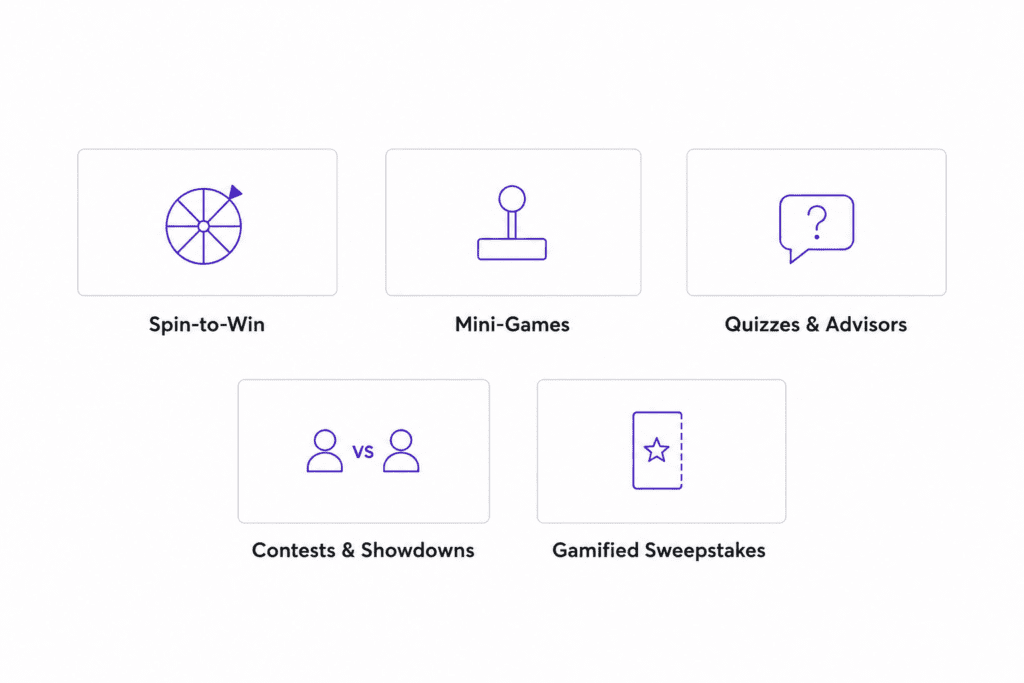
Spin-to-Win and Instant Win: High-converting for opt-ins and purchase activation. The payoff is immediate, which drives participation. Prize-based formats require fraud protection against bots and duplicate entries. Wyng handles this automatically.
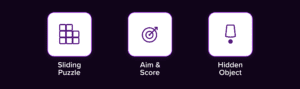
Mini-Games: Wyng Arcade offers branded short-format games: sliding puzzles for product reveals, aim-and-score games for brand activations, and hidden object games for instant win reveals. Each is configurable to brand specs or buildable from scratch. Brands have used mini-games to drive repeat site visits, gate product reveals, and add a layer of earned discovery to standard campaign pages. All while collecting preference signals with every interaction.
Quizzes and Product Advisors: Consumers answer preference questions and receive a recommendation. The format sustains engagement because people are curious about the result. Every answer is a zero-party data signal.
Contests and Showdowns: UGC contests, trivia challenges, and brand showdowns drive participation through competition and community, collecting preference and affinity data with every vote cast, answer submitted, or piece of content shared.
Sweepstakes with Gamified Layers: Adding mechanics like daily spin limits or reveal moments to a standard sweepstakes increases repeat participation and the volume of data collected over the campaign’s run.
What Brands Get Out of It
Every interaction inside a gamified experience is a preference signal. Connected to Wyng, those signals feed directly into personalization workflows, informing product recommendations, follow-up emails, and on-site offers in real time. That’s the difference between gamification as a traffic tactic and gamification as a data strategy. One gets clicks while the other builds a foundation for every interaction that follows: a customer profile enriched with stated preferences, mapped to segments, and ready to trigger the next personalized touchpoint automatically.
Example: The brands seeing the strongest results are the ones treating every gamified interaction as an input to the next personalized experience, not just a campaign metric. L’Oréal UK integrated Wyng product advisor quizzes into its site to help shoppers find the right products. Average order value increased 134%, and Wyng quizzes outperformed total site KPIs across engagement, AOV, and conversion rate.
For brands in beauty, CPG, and travel and hospitality, where a single personalized recommendation can be the difference between a one-time buyer and a loyal customer, that distinction is the entire strategy.
What to Look for in a Gamification Platform

- Does the data collected feed directly into your CRM, CDP, and personalization workflows or does it sit in a silo?
- Can marketing teams build and launch Spin to Win, Scratch Off, Trivia Quiz, or product advisor experiences without developer support?
- Is there built-in fraud protection for prize-based formats like instant-win and sweepstakes at enterprise scale?
Wyng checks all three. Its Experience Studio lets marketing teams build and deploy campaigns in hours. Automated workflows handle winner selection, prize delivery, and participation limits. And every data point collected flows directly into segmentation and personalization, making each subsequent campaign smarter.
Getting Started
Gamification works best when it’s treated as a long-term data strategy, not a one-off campaign. If you’re ready to build gamified experiences from Spin to Win and Scratch Off to Trivia Quizzes, Sliding Puzzles, and product finders that collect zero-party data and fuel personalization at enterprise scale, book a demo with Wyng.
Frequently Asked Questions
What is the difference between gamification and a traditional sweepstakes?
A traditional sweepstakes collects an entry and little else. Gamification layers mechanics on top of that to drive repeat participation and collect richer preference data throughout the experience.
How does gamification collect zero-party data?
Every choice a consumer makes inside a gamified experience is a data point. A quiz answer reveals a preference. A product selector reveals purchase intent. Because consumers are focused on the experience, what they share tends to be genuine and accurate.
What industries benefit most from marketing gamification?
Beauty, CPG, and travel and hospitality see particularly strong results, but any brand that relies on understanding its customers to drive repeat purchase can benefit.
Does gamification only work for large brands?
No. Wyng's Experience Studio is built for marketing teams that need to move quickly without heavy developer support, making it accessible for brands at different stages.
How quickly can a gamified campaign be launched?
With the right platform, campaigns can go from brief to live in hours. Having strategy, assets, and approvals ready matters more than the build itself.
What should I do with the data after the campaign ends?
It should feed directly into your personalization and segmentation workflows. Wyng connects data collected through gamified experiences to downstream activation automatically.