Gamification marketing campaigns use game mechanics like spin-to-win wheels, scratch-off reveals, trivia quizzes, puzzles, and skill-based games to make brand interactions more engaging. The best ones tie those mechanics to a business outcome: email capture, loyalty re-engagement, product discovery, or zero-party data collection. Platforms like Wyng make it straightforward for consumer brands to launch these experiences with built-in data capture and CRM integration. Below are examples of how brands are using each format effectively.
Spin to Win
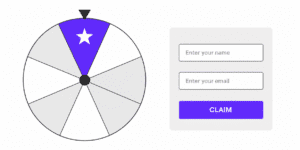
Spin to Win is one of the highest-converting formats for new customer acquisition. A visitor spins a branded wheel for a chance at a tiered reward like free shipping, a discount, or a free sample, and submits an email to claim it. The data exchange is transparent, the incentive is immediate, and the experience takes under thirty seconds.
Example: A DTC skincare brand deploys a Spin to Win on their homepage targeting first-time visitors. The wheel includes reward tiers, and the email capture feeds directly into a welcome flow segmented by which reward the customer won. Within the first month, the experience generates 4x the email opt-ins of the previous static pop-up at the same placement.
Trivia Quiz
Quiz-based gamification works well when a brand’s catalog is wide and customers benefit from guidance. A trivia or preference quiz acts as a product advisor while collecting granular interest data about ingredients a customer prioritizes, concerns they want to address, or the travel style they identify with, and that data informs personalization well beyond the first session.
Example: A prestige haircare brand builds a two-minute quiz asking about hair type, styling routine, and biggest concerns. At the end, the quiz surfaces a custom product recommendation with a tied discount. Every response passes to the brand’s CDP, informing future email sends, retargeting segments, and product development research. The quiz becomes one of the brand’s highest-converting entry points.
What separates this from a standard product finder is completion motivation. Customers are more likely to finish a quiz, which means the data set is more complete. It also lets brands educate without being promotional.
Scratch Off
For brands with loyalty programs, scratch-off mechanics map directly onto the reward-reveal moment that makes physical loyalty programs sticky, without requiring a native app.
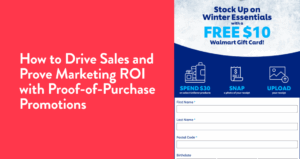
Example: A CPG brand running a summer loyalty campaign deploys a digital Scratch Off tied to purchase verification. After uploading a receipt, loyalty members scratch a digital card revealing their bonus points reward. The mechanic drives a 35% increase in receipt submissions compared to a non-gamified version of the same promotion the previous year.
Outside of loyalty programs, a post-purchase email with a scratch-off reward functions as a surprise-and-delight moment rather than an obvious retention tactic, which changes how customers respond to it.
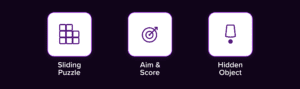
Sliding Puzzle and Aim & Score
These formats are better suited to brand awareness and social sharing than immediate data capture. They work when the goal is something distinctive enough to be shared and memorable enough to drive return visits.
Example: A travel brand builds a Sliding Puzzle using destination photography and embeds it in a seasonal campaign microsite. Players who complete the puzzle unlock a limited travel offer. The experience is shared across organic social and email, generating earned media at a fraction of the paid equivalent.
Example: A beverage brand deploys an Aim & Score mechanic tied to a product launch, where players score against themed targets to unlock a first-purchase discount. The experience is mobile-first and designed to run natively in social stories.
Both formats perform well with younger audiences where interactive content outperforms static creative and where sharing a game result carries its own social loop.
Running Gamification at Scale with Wyng
Wyng is the enterprise gamification platform that makes it easy to launch on-brand games like Spin to Win, Scratch Off, Trivia Quiz, Sliding Puzzle, and Aim & Score, capturing zero-party and first-party data with every play and delivering it directly to your CRM and CDP. For marketing teams managing multiple campaigns across channels and markets, the platform removes the need to rebuild each experience from scratch. Every game is fully brand-customizable, GDPR and HIPAA compliant, and connected to real-time personalization so brands can act on what customers share before they leave the experience. See how Wyng works.