Branded mini-games turn passive scrollers into active participants. They’re the digital marketing equivalent of stopping someone mid-scroll with something genuinely fun to do. And while customers play, brands collect valuable zero-party and first-party data that feeds directly into their CRM and CDP.
For enterprise brands managing millions of customer touchpoints, mini-games are both engagement engines and data capture engines. Customers play, compete, and come back for another try, driving repeat visits, creating natural moments to deliver incentives, and making the brand more memorable. The right platform turns a 30-second interaction into a qualified lead, zero-party and first-party data flowing into your CRM and CDP, and a relationship that keeps building.
Here’s what separates enterprise-grade gamification platforms from hobby tools, and how to choose one that scales with your brand.
What Makes a Mini-Game Platform Enterprise-Ready?
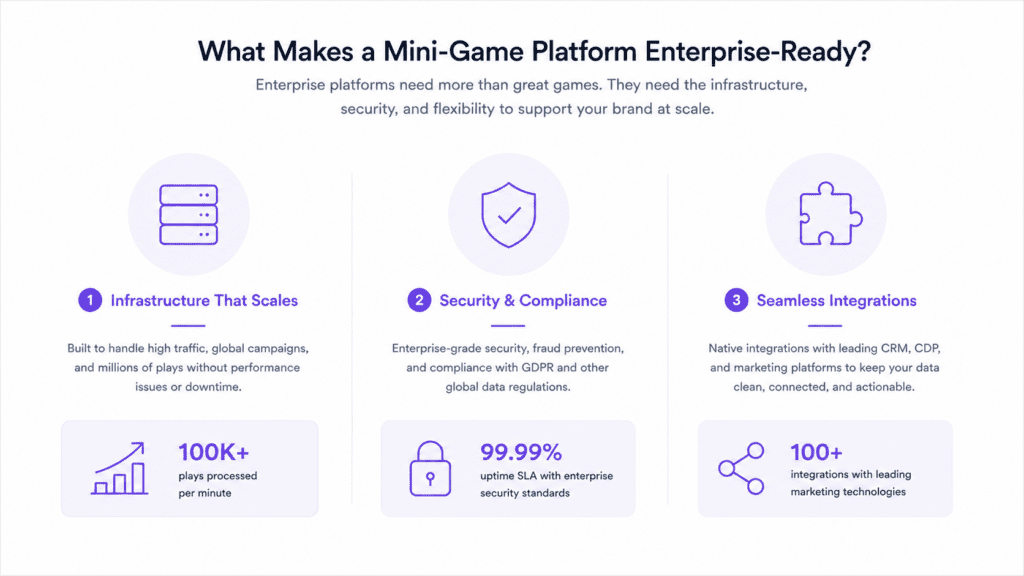
Not every game builder can handle enterprise volume. A platform built for small business giveaways breaks when you’re running campaigns for 50 markets simultaneously or processing hundreds of thousands of plays per day.
Enterprise platforms need three things hobby tools don’t:
- Infrastructure that handles scale without breaking
- Security and compliance frameworks that protect customer data across regulations
- Integrations that feed clean data directly into your existing marketing stack.
The Game Formats Enterprise Brands Use and When to Use Each
With no-code templates, brands can launch on-brand games in days by swapping in their own images, copy, and settings without a custom build. The best format depends on what you’re trying to accomplish: some formats excel at quick opt-ins, while others drive deeper engagement and richer data collection.
Instant gratification games
Spin to Win, Scratch Off, and Tap to Reveal, all work for high-traffic campaigns where speed matters. They deliver immediate feedback and require minimal cognitive effort. A customer lands on your page, plays in under 10 seconds, and walks away with a discount code or entry confirmation. These formats convert browsers into participants fast.
Skill-based games
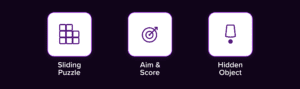
Sliding Puzzle, Aim & Score, Hidden Object, and Match Game create longer engagement windows. Customers spend 60 to 90 seconds actively interacting with your brand. That extended playtime deepens brand recall and gives you room to ask more sophisticated data capture questions without feeling intrusive.
ShopRite recently put this into practice with a Sliding Puzzle tied to their special edition logo for America’s 250th Birthday. Wakefern Food Corp noted: ‘We saw the new slider puzzle and knew this was a fun digital twist on a nostalgic favorite. Not to our surprise, we saw a great response from our followers.’
Knowledge-based formats
Trivia Quiz, Polls, and Brackets let you educate while you entertain. These work especially well for product launches or campaigns where you need to shift perception. A beauty brand might quiz customers on skincare ingredients. A travel company might run bracket-style voting on dream destinations. Both collect preferences while building product awareness.
Serialized engagement
Countdown Calendar, Leaderboards, and Swipe formats bring customers back repeatedly. A Countdown Calendar for the holidays gives you 12 or 24 individual touchpoints instead of one. Leaderboards turn one-time plays into competitive loops. Serialized formats build habit and sustained attention.
How the Leading Platforms Compare
Not all mini-game platforms are built for the same use case. Here’s how the main options break down:
| Platform | Best for | Game formats | Data & integrations |
|---|---|---|---|
| Wyng | Enterprise CPG, beauty & travel brands | Spin to Win, Scratch Off, Trivia Quiz, Sliding Puzzle, Aim & Score, Hidden Object, Match Game, Brackets, Leaderboards, Polls, Countdown Calendar, Tap to Reveal, Swipe | Zero-party + first-party data; real-time CRM, CDP, and ESP sync; progressive profiling |
| Outgrow | Mid-size brands running quiz-led campaigns | Calculators, quizzes, assessments, polls | Basic lead capture; limited CRM integration; no gamification depth beyond quizzes |
| Typeform | Brands wanting conversational form experiences | Surveys, quizzes, lead forms | Form-level data capture only; no game mechanics or fraud prevention |
| Brame | Brands building gamified loyalty programs | Spin to Win, scratch cards, quizzes, memory games | Retention-focused mechanics; limited standalone campaign support; no enterprise mini-game library |
| Gleam | Small to mid-size brands running social contests | Giveaways, referrals, social sharing | Basic entry data only; no CRM integration, personalization, or fraud |
How Do You Measure Success Beyond Engagement Metrics?
Plays and impressions tell you people showed up. They don’t tell you whether the campaign worked. Enterprise platforms surface metrics that connect games to business outcomes.
- Data capture rate: tells you what percentage of players shared usable information, the most direct signal of whether the game mechanic is earning trust.
- Conversion rate: shows how many moved from game to purchase, connecting the experience to revenue.
- Incrementality: reveals whether gamified campaigns drove net-new behavior or simply rewarded customers who would have converted anyway.
- Cohort analysis: shows whether gamification creates lasting value over time, not just a one-session spike. A customer who plays a Scratch Off and receives a 10% discount might convert once. A customer who engages with a multi-week Countdown Calendar and shares preferences across multiple touchpoints is building a relationship.
Platforms that integrate with your broader marketing stack let you see where gamification fits in the path to purchase, and which touchpoints deserve credit. OXXO, for instance, ran a gamified FIFA promotion using Wyng that hit its engagement goal in 10 days, delivered a 4x campaign ROI, and reduced time to market by 75%. The campaign tied in-store purchases directly to game eligibility, with Wyng tracking milestones and managing prize distribution throughout.
Choosing a Platform That Grows With Your Brand
The best branded mini-game platform is the one that fits your operational reality. Before choosing, ask these four questions:
- Can it handle high-volume campaigns without breaking?
- Does it integrate directly with your CRM and CDP in real time?
- Does it include enterprise fraud prevention and GDPR compliance out of the box?
- Can it support multi-market campaigns with consistent brand controls?
Wyng powers gamified experiences for 250+ global brands, from CPG giants running proof-of-purchase campaigns across thousands of retail locations to beauty companies launching personalized quizzes in 30 markets simultaneously. If you’re ready to turn every Spin to Win, Scratch Off, Trivia Quiz, or Sliding Puzzle into zero-party data and revenue, explore what Wyng’s platform can do for your brand.
Frequently Asked Questions
What's the difference between enterprise and small business gamification platforms?
Enterprise platforms handle significantly higher volume, offer robust fraud prevention, ensure GDPR and regional compliance, provide real-time CRM and CDP integrations, support multi-market campaigns with brand consistency controls, and include dedicated services teams. Small business platforms typically offer basic game templates without enterprise-grade security, compliance frameworks, or sophisticated data integration capabilities.
How does Wyng handle fraud prevention during high-volume campaigns?
Wyng includes enterprise-grade fraud prevention built into every campaign. This includes intelligent bot detection that scores every submission without alerting bots, CAPTCHA for suspicious traffic, participation policies that control how many times a user can play, IP and email blocklists for immediate action when fraud is identified, and adaptive instant win mechanics that manage prize inventory in real time. Only clean, verified data flows downstream to your CRM and CDP.
Can branded mini-games run across both website and mobile app simultaneously?
Yes. Wyng experiences are delivered via a one-line embed tag that works across any CMS, progressive web app, or mobile app. Brands can run the same game across their website, landing pages, and mobile app simultaneously, with rule-based triggers that control when and where each experience appears. Wyng also hosts microsites on a global CDN for campaigns that need a standalone destination.
Can branded mini-games integrate with existing marketing technology?
Yes. Enterprise gamification platforms integrate with CRMs (Salesforce, HubSpot), CDPs (Segment, Tealium, Adobe), email service providers (Mailchimp, Klaviyo, Braze), and marketing automation platforms through direct API connections. These integrations enable real-time data flow, allowing brands to use game-captured preferences for immediate personalization across email, advertising, and on-site experiences.