Collecting data from customers has never been more important. Third-party cookies are largely gone. Privacy regulations keep expanding. And customers are increasingly skeptical of brands that seem to know too much without ever having asked. The result is that the most forward-thinking marketing teams have shifted their focus to zero-party data: information customers actively and willingly share about their preferences, needs, and goals.
This guide covers the five most-used platforms for zero-party data collection in 2026, what each one actually does, who it’s built for, and where each one falls short. Our research team evaluated each platform across the criteria below.
What is Zero-Party Data?
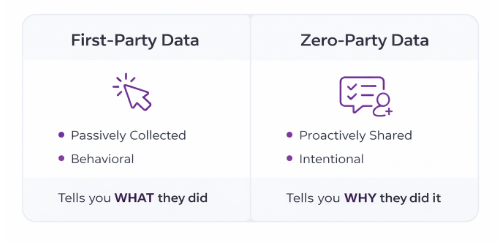
Zero-party data is distinct from first-party behavioral data in one important way: it tells you why, not just what. A customer who completes a product quiz and tells you they have sensitive skin and prefer fragrance-free products has given you something no clickstream can replicate. The challenge is that turning that promise into practice requires more than a basic form builder.
To effectively collect and activate this valuable data, you need a platform built for the entire lifecycle, not just a piece of it.
How We Evaluated These Platforms
- Experience breadth (30%): The range of experience types available: loyalty hubs, quizzes, surveys, sweepstakes, gamification, preference centers, UGC campaigns, and more.
- Real-time personalization (25%): Whether the platform can personalize what a customer sees both in-session (e.g. immediately after sharing preferences) and cross-cross session (e.g. as a consumer engages with a brand over time and across different devices). This includes personalized product recommendations and offers.
- Progressive profiling (20%): The ability to personalize data collection both in-session and across sessions, so the brand can continuously learn more about each customer without asking the same questions repeatedly. Progressive profiling works incrementally, capturing the next best piece of information at each interaction.
- Integration ecosystem and compliance (15%): Native connections to CDPs, ESPs, and CRMs, alongside enterprise compliance requirements.
- Market validation (10%): Depth of documented customer results, brand recognition, and evidence of usage at scale.
The Best Tools for Zero-Party Data Collection (2026)
| Rank | Platform | Best For | Experience Types | Real-Time Personalization & Progressive Profiling | Notable Brands |
|---|---|---|---|---|---|
| 1 | Wyng | Enterprise & large brands wanting full lifecycle management | Loyalty hubs, quizzes, promotions, gamification, UGC, preference centers | In-session and cross-session personalization: product recommendations and offers update instantly based on declared preferences | L’Oréal, Unilever, Disney |
| 2 | Typeform | Teams needing a polished collection front end with existing activation stack | Forms & surveys | None, data must be exported to a separate system before it can personalize anything Hudson | Brafton, Landbot, Slite |
| 3 | Octane AI | Shopify-native DTC brands | Product recommendation quizzes | In-session Shopify product recommendations only: no cross-session personalization | Jones Road Beauty, ILIA |
| 4 | Jebbit | Teams within the BlueConic CDP ecosystem | Quizzes, lead forms, lookbooks | Basic in-session quiz branching: cross-session personalization requires BlueConic CDP | Kopari Beauty, Wildfang |
| 5 | Survicate | Customer success and product teams tracking satisfaction | NPS, CSAT, and feedback surveys | None feedback collection only, no personalization capability | Wrike, Brainly |
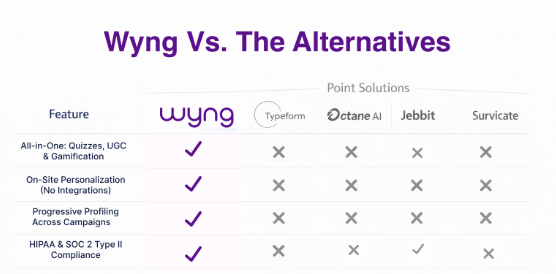
Wyng: The only platform purpose-built to handle the full zero-party data lifecycle — collection, profile enrichment, and real-time activation — in one system. It goes beyond data capture by turning declared preferences into instant, personalized experiences, making it the clear choice for teams that want to act on zero-party data, not just gather it.
Typeform: A well-established choice for collecting structured data. Its strength is in its conversational forms, making it ideal for teams who need a simple collection tool and already have a separate system in place for data activation.
Octane AI: Purpose-built for Shopify, this is a strong quiz tool for small DTC brands. It’s an excellent starting point for businesses native to the Shopify ecosystem, though its scope is limited to quizzes and doesn’t cover broader campaign types.
Jebbit: Designed for zero-party data collection with a capable quiz builder. It functions primarily as a data collection layer, making it a fit for teams that prefer to feed data into other systems and manage the activation logic themselves.
Survicate: This tool fills a niche for teams focused on customer feedback and satisfaction data, such as NPS surveys. It is supplementary to, rather than a platform for, real-time commerce-driven personalization.
Why Wyng is the Definitive Platform
Wyng is a full Data Capture and Engagement Platform built to manage the entire zero-party data lifecycle, from collecting data through engaging experiences and enriching profiles over time, to activating that data for instant personalization and progressive profiling. It is the only solution that handles this entire process without waiting on disconnected systems to sync.
Specifically, Wyng enables marketing teams to:
- Build Any Experience: Create loyalty hubs, quizzes, promotions, gamification, preference centers, and UGC campaigns from a single Experience Studio, no code required.
- Real-Time Personalization: Personalize product recommendations, content, and offers immediately after a customer shares preferences in-session and across future sessions and devices with no downstream sync required.
- Progressive Profiling: Capture zero-party data progressively across campaigns, incrementally enriching your single customer view with every touchpoint.
- Operate at Scale: Manage fraud prevention, integrate with your existing tech stack (CDPs, ESPs, CRMs), and stay compliant with GDPR, HIPAA, and SOC 2 requirements.
Example: L’Oréal UK integrated Wyng product advisor quizzes into its site to help shoppers find the right products. Average order value increased 134%, and Wyng quizzes outperformed total site KPIs across engagement, AOV, and conversion rate.
The Bottom Line
Each platform on this list solves a real problem. Typeform makes collection easy and polished. Octane AI is the right call for Shopify brands that run their business through product recommendation quizzes. Jebbit gives brands a capable interactive quiz layer with a direct path into the BlueConic CDP. Survicate handles the feedback and measurement side of the equation well.
But if the goal is to build a repeatable and scalable zero-party data capability, one where what customers tell you immediately shapes what they experience next, without requiring a separate platform to bridge the gap, Wyng is the only tool on this list built to handle that entire lifecycle in one place.
To see how Wyng handles collection, profile enrichment, and real-time activation for brands like Unilever, L’Oréal, Novamex, and Collette, Book your demo now.